2019 Grand Finale: three Silver Masters vying for the Gold Master
In the summer of 2019, Masters de Feu prepared its first grand finale in Compiègne, with Italy, Greece and France gathered for an exceptional pyrotechnic duel. Identical budgets, fixed duration, shared theme and blind voting: everything was designed to celebrate creativity, emotion and mastery of fire.
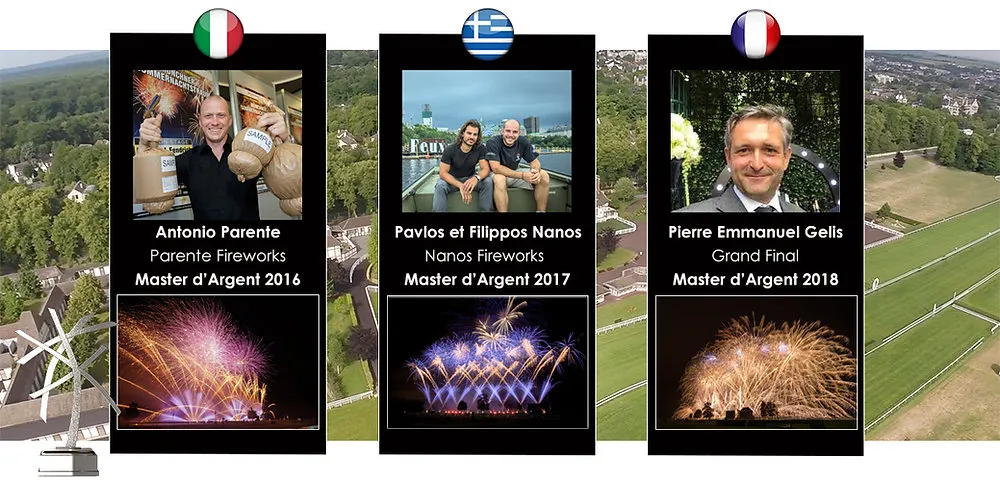
With nearly two months to go before the 2019 Grand Final, Masters de Feu entered a rare sequence: one in which three already crowned winners returned to Compiègne to compete once more, no longer to claim a Silver Master, but to aim for the Gold Master. Italy, Greece and France, chosen in the three previous editions, were preparing to meet the public and the jury again in a gala setting at the Hippodrome de Compiègne, under the same conditions: fifteen minutes of show time, an equivalent budget and a shared theme. The stakes went beyond simple competition. It was about deciding between three pyrotechnic signatures, three sensibilities, three ways of composing with music, space, colour and rhythm.
A final conceived as a prestigious rendezvous
The Grand Final on 21 September 2019 held a special place in the history of Masters de Feu. After three years of selection, the competition brought together the winners of the 2016, 2017 and 2018 editions for a highly anticipated showdown. The principle was clear: the companies that had won the Silver Master returned to defend their place among the leading pyrotechnic houses invited to Compiègne. This final format gave the competition an almost sporting dimension, but with the codes of a major spectacle: long preparation, meticulous staging, artistic tension, audience anticipation and the jury’s verdict.
In the stands, the event already promised a rich, popular and spectacular evening. On the field, the teams knew they would not be able to impress through sheer power or abundance alone. In a competition at this level, every second counts: the rise in intensity, the breathing space between sequences, the precision of the launches, the interplay between effects and soundtrack, the choice of products, the height of the tableaux, the clarity of colours and the dramatic arc all become decisive elements.
Italy, Greece, France: three finalists, three pyrotechnic temperaments
The final brought together three nations already part of the recent memory of Masters de Feu. Italy, represented by Parente Fireworks, arrived buoyed by its success in the first edition. Greece, with Nanos Fireworks, had secured its place in 2017. France, led by Grand Final, had joined this circle of finalists after the 2018 edition. These three teams were not simply defending a flag: they embodied schools, gestures, fire cultures and distinct aesthetics.
The presence of a French company naturally added a particular intensity to the evening. Playing at home can be an emotional advantage, but also an added pressure. Faced with a largely French audience and a jury attentive to fairness, the organisers therefore chose to frame the competition with a strong rule: conceal the identity of the competitors at the moment of voting. This blind voting principle was meant to refocus attention on what mattered most: the show itself.
Fifteen minutes to convince: a demanding format
Each company had the same firing time: fifteen minutes. This format, generous for the audience and highly demanding for the pyrotechnicians, requires real dramaturgy. Too short, a show may lack scale; too dense, it may lose its breathing space. In a quarter of an hour, one must set the mood, develop an idea, surprise, move the audience, maintain musical synchronisation and end with a powerful signature. The duration thus becomes a framework for composition, almost a score in itself.
Equality also applied to the budget. This point is essential in an international competition, as it ensures victory is based not on greater means, but on the intelligence of the concept. With equivalent budgets, artistic choices stand out more clearly: should one favour the finesse of low-level sequences, the verticality of large calibres, the originality of effects, the purity of colours, the density of bouquets, the musical narrative or the final surprise? It is in these decisions that a fireworks house’s personality is revealed.
The theme of great works, a guiding thread for the evening
For this Grand Final, the competitors had to work around a shared theme: great works. It is a vast, prestigious, but demanding subject. It invites the use of a strong cultural imagination, calling on musical or artistic references that are immediately evocative, while avoiding overly literal illustration. Fireworks do not tell stories like cinema, do not paint like a canvas and do not sing like an orchestra; they translate through flashes, silences, accelerations, luminous textures and ephemeral architectures.
This theme therefore offered an ideal ground for judging the finalists’ ability to build emotion. A great work can inspire solemnity, romance, energy, melancholy or exaltation. But pyrotechnics must find the right language: a gold burst can become an orchestral accent, a red comet can underline tension, a blue fan can open space, a silver sequence can suspend time. In this dialogue between music and fire, synchronisation alone is not enough; it must serve a vision.
A jury guided by four precise criteria
The jury was to score each performance out of twenty according to four criteria: aesthetics, emotion, synchronisation and the diversity of choreographed products. These criteria capture the demanding nature of Masters de Feu very well. Aesthetics assess overall beauty, the balance of tableaux, the quality of colours and the elegance of composition. Emotion measures the show’s ability to move the audience, to create wonder, surprise or a thrill. Synchronisation evaluates the precision between effects and the soundtrack. Diversity, finally, distinguishes creations able to vary textures, heights, rhythms and visual signatures.
In a final, these criteria become even more important. The competitors are all seasoned; none is discovering the pressure of a major competition. The difference is therefore made in the details: a perfectly controlled silence, a smooth transition, a finale that begins neither too early nor too late, a coherent sequence of colours, a rare effect placed at the right moment. Masters de Feu thus reminds us that competitive pyrotechnics are not only about power: they are an art of measure, precision and tempo.
Blind voting, to preserve suspense and fairness
One of the major new features announced for this final was blind voting. Each competitor was to be identified by a number, not by country or company name, at the time of assessment. The jury was therefore voting for a show, not for a reputation. This rule heightened suspense for spectators, but above all it answered a fairness issue. In a competition where France was among the finalists, it was essential that appreciation remain focused on the quality of the creation presented in the sky.
This system also added a playful dimension to the evening. The audience could try to recognise a school, a way of building sequences or a stylistic colour, without immediate certainty. Nationalities were only revealed after the jury’s decision, extending the anticipation all the way to the verdict. In an event so visually driven, this element of mystery made perfect sense: before the flags, before the rankings, there was first the experience of the sky, shared emotion and the force of the moment.
An evening designed for the public of Compiègne
Masters de Feu has always been built on a strong relationship with the public. The 2019 Grand Final was its most accomplished illustration: three competing shows, an iconic setting, an overall stage design and a clear promise of an evening where every tableau could change the standings. In Compiègne, fireworks become a collective event, a moment when people look up together, generations mingle and technique disappears behind sensation.
For fireworks artists, this closeness to the public is a responsibility. A competition is not won only on the score sheet; it is also won in the memory of spectators. The Grand Final therefore invited the teams to find the balance between virtuosity and clarity, sophistication and immediate emotion, artistic ambition and popular enjoyment. It is precisely this tension that makes Masters de Feu unique: an exacting international competition, yet conceived as a grand celebration of pyrotechnic performance.
The Gold Master, the horizon of an exceptional competition
By bringing together three Silver Master winners around a single objective, the 2019 Grand Final carried a simple and powerful promise: to name the Gold Master winner. This trophy did not reward only a fifteen-minute performance. It honoured a journey, the ability to return before the public with a new proposal, to accept direct comparison with other champions and to become part of the history of an international competition that has become one of Compiègne’s major pyrotechnic highlights.
As the evening approached, all the ingredients for anticipation were in place: three top-level finalists, shared rules, a unifying theme, a structured jury, blind voting and the prospect of a closely fought verdict. The Grand Final was not presented as a simple addition of fireworks, but as a complete artistic confrontation. In the sky above Compiègne, Italy, Greece and France were preparing to turn competition into a luminous story, with one question left unanswered: which creation would strike the right note and deserve the Gold Master?