The secrets of a pyrotechnic show: from the idea to the final bouquet
A grand fireworks display is never improvised: it is composed like a score, with a theme, a soundtrack, scenes, and a gradual rise in emotion. From musical choices to electronic firing, go behind the scenes of a pyrotechnic show as you might admire at Masters de Feu.
In the sky, everything seems to burst forth in a flash: a spray of gold, a rain of stars, a red blaze answering a musical phrase, then silence before the next explosion. And yet, behind this apparent spontaneity, a pyrotechnic show is one of the most demanding forms of stage writing. It is not simply a matter of setting off fireworks, but of building a complete dramaturgy, designed for a site, an audience, a duration, a score and an emotion. At Masters de Feu, in Compiegne, this precision takes on its full meaning: every second counts, every color tells a story, every launch contributes to a collective work visible beneath the open sky.
A pyrotechnic show is not just fireworks
In everyday language, the two expressions are often used as synonyms. Fireworks evoke celebration, Bastille Day, rockets lighting up a square, a park or a seafront. A pyrotechnic show goes further. It brings together artistic intent, staging, progression and, very often, a soundtrack. Pyrotechnics then become an art of time: they work with anticipation, surprise, rhythm, contrast and the viewer’s visual memory.
In France, the concept of a pyrotechnic show also follows a precise regulatory framework, particularly when a significant quantity of active material is used or when professional-grade articles are employed. This technical and regulatory dimension is a reminder of an obvious fact: the beauty of the result first depends on rigorous organization. The audience sees the poetry; the pyrotechnicians work with safety distances, firing plans, authorizations, checks and procedures.
It all begins with the firing site
Before even choosing a soundtrack or a color palette, the creators study the site. A show fired from a barge, a monument, a stadium, a park or a racecourse is not written in the same way. Geography determines the possible heights, launch angles, firing width, safety zones and the way the audience will perceive the whole. The Compiegne racecourse, with its openness and depth, offers for example a broad reading of the sky: pyrotechnicians can work there on lines, volumes, panoramic effects and sequences that have room to breathe.
The venue also creates a particular relationship with the horizon. Some sites call for spectacular vertical effects, while others are better suited to low-level fans, stage jets, candles, comets or spread effects. The first question is therefore not: “What will we fire?” but rather: “What does the site allow, and how can we elevate it?” A good pyrotechnic show does not fight its setting. It uses it.
The theme sets the artistic direction
Then comes the theme, when it is defined by the organizer or the competition. It gives the show its overall tone, both literally and figuratively. A theme linked to great works, cinema, travel, the seasons or mythology will not call for the same musical choices or the same effects. The goal is not to illustrate every word naively, but to create coherence. The theme acts as a compass: it helps the pyrotechnician choose tempos, moods, transitions, intensities and moments of breathing space.
This stage is almost akin to musical composition. The designer imagines an emotional journey: an opening that captures attention, tableaux that establish successive atmospheres, then a finale capable of leaving a powerful imprint. A successful show does not begin at maximum power. It carefully paces its effects, creates expectations, holds the gaze, relaunches energy and prepares the final apotheosis. As in theater or opera, intensity must build without exhausting the audience too early.
Music, the true backbone of the show
In a pyromusical show, the soundtrack is not a mere accompaniment. It becomes the score on which the pyrotechnicians write their images. Bursts, shell openings, sprays, whistles, crackles or volleys can all be synchronized with a drumbeat, a string crescendo, a silence, an electronic break or a choir. Music sets the pace; pyrotechnics provide the light.
The choice of pieces is therefore decisive. Music that is too linear risks producing a monotonous sky. By contrast, a strongly contrasted soundtrack makes it possible to vary the tableaux: warm colors for an intense sequence, white or blue tones for a more contemplative mood, sparkling effects for delicacy, rapid volleys for exhilaration. The designer must hear what the audience will see. Every musical accent can be answered by a luminous figure; every silence, by a visual suspension.
Opening, tableaux, final bouquet: a three-part structure
The classic structure of a pyrotechnic show follows a simple but formidable logic. The opening establishes the show’s signature. It must be strong enough to seize the audience, without exhausting all resources at once. The tableaux then form the heart of the show. There may be five, six, seven or more, depending on the duration and ambition of the creation. Each has its own color, rhythm, dominant effects and place in the overall progression.
The final bouquet, meanwhile, meets an almost universal expectation. It must gather the accumulated energy and give the audience a sense of fulfillment. That does not simply mean firing more product. A successful final bouquet relies on controlled acceleration, readable density and a strong sense of timing. Too short, and it disappoints; too long, and it dilutes the emotion. The great art lies in reaching the exact point of incandescence, where the sky seems to fill completely before falling back into night.
Software has transformed pyrotechnic precision
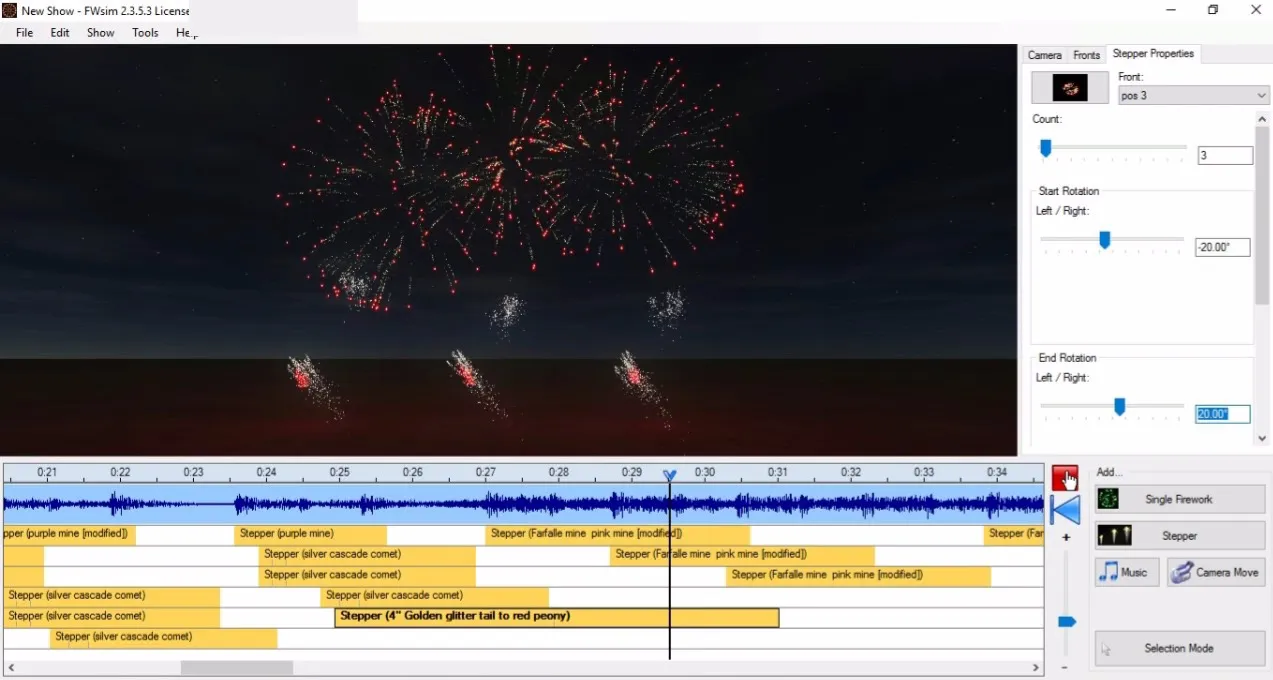
Contemporary fireworks writing relies on highly advanced digital tools. Design software makes it possible to prepare the firing plan, link effects to music and preview the show’s overall sequence. Electronic firing systems bring remarkable precision, down to fractions of a second. It is this finesse that makes highly rhythmic sequences possible, where the effects seem to dance to the millimeter with the soundtrack.
These tools do not replace the pyrotechnician’s eye. They help with anticipation, organization, verification and refinement. Previewing gives an idea of the result, but never fully reproduces the real experience. Wind, air humidity, the audience’s perception, the site’s acoustics and the depth of the sky always alter the final sensation. Pyrotechnics remain a living art: prepared with extreme rigor, but fully brought to life only at the moment of firing.
The personality of the pyrotechnicians can be read in the effects
Like a chef selecting ingredients, a pyrotechnician builds a vocabulary with shells, comets, candles, volcanoes, fountains, maroons, twinkling effects, crowns, peonies or palms. Some articles are purchased from specialized manufacturers; others may come from the particular expertise of a pyrotechnic house. This diversity explains the richness of international competitions: Italy, Spain, China, France, the United Kingdom and other major pyrotechnic traditions each bring their own signature.
Color, too, demands great mastery. A deep red, a pure blue, a dense gold or a silver white do not create the same emotion. Sound effects also matter: crackling, whistling, muffled detonations or delicate cascades can support the dramaturgy. In a competition such as Masters de Feu, this writing becomes a way to stand out. It is not enough to impress; you must surprise, move and remain coherent from the first tableau to the last.
Emotion is born of precision
Therein lies the paradox of a great pyrotechnic show: the more precise the work, the more natural the magic appears. The audience sees neither the firing files, nor the hours of synchronization, nor the discarded options, nor the safety constraints. They see a luminous fresco that seems to unfold effortlessly. This illusion is the reward of the craft. It turns chemistry into poetry, electronics into rhythm, technique into shared memory.
To write a pyrotechnic show is therefore to compose with the invisible as much as with the light. It is to anticipate the impact of an explosion before it exists, to imagine the color of a silence, to measure the effect of one second of waiting. At Masters de Feu, this high standard meets the energy of an international competition and the attention of an audience gathered to look up together. When the final bouquet fades, only a little smoke remains in the sky. But in the spectators’ memory, the show continues to shimmer for a long time.