History of pyrotechnics: from black powder to grand spectacles
Born of legend, science and craftsmanship, pyrotechnics has spanned the centuries, accompanying festivities, victories, ceremonies and great popular celebrations. From ancient China to contemporary pyromusical creations, its history tells as much of the evolution of chemistry as of our collective fascination with light.
Where do fireworks come from? The answer lies somewhere between historical investigation, legend, and the history of science. Long before becoming the luminous structures that set today’s major events alight, pyrotechnics were first a chemical discovery—a matter of powder, smoke, sound, and fascination. They travelled from China to Europe, from battlefields to royal squares, from artisan workshops to international competitions. Their story is that of a spectacular art that has never ceased to evolve.
At the origins: fire, bamboo, and black powder
The exact origins of fireworks remain difficult to date with certainty. The earliest accounts point to China, where bamboo stalks are said to have first been thrown into the fire. Under the effect of heat, the air trapped in the bamboo’s natural hollows expanded until it caused a detonation. These dry explosions were believed to ward off spirits, mark rituals, or accompany festive moments.
The real turning point came with black powder, a mixture of saltpeter, sulfur, and charcoal. Historians generally place its emergence in China between the 9th and 10th centuries, at a time when alchemists were less interested in entertaining than in experimenting with substances capable of transforming matter. This initially unstable powder gradually became a dual-purpose tool: military for its power, festive for its sound and light effects.
When powder becomes spectacle
The earliest fireworks did not have the chromatic brilliance of today’s displays. They mainly produced flashes, smoke, whistles, showers of sparks, and explosions. Their power lay in contrast: the darkness of night suddenly pierced by fire, silence broken by detonation, the surprise of a phenomenon at once controlled and dangerous. Even then, pyrotechnics rested on a tension that remains at the heart of the craft: mastering the unpredictable.
In China, these uses developed within festivals, ceremonies, and public celebrations. Pyrotechnics are not merely entertainment: they belong to a symbolic imagination in which noise drives away misfortune, light announces joy, and fire becomes a collective language. This ritual dimension explains in part the lasting presence of fireworks in popular culture.
The road to Europe and the rise of the Renaissance
Black powder gradually spread to the West, notably from the Middle Ages onward. Its circulation accompanied technical, military, and commercial exchanges between Asia, the Arab-Muslim world, and Europe. Europeans quickly understood its strategic value. But alongside its warfare uses, pyrotechnic effects also captivated princely courts and cities seeking a spectacular expression of power, victory, or religious celebration.
During the Renaissance, Italy played a major role. Specialized workshops emerged, pyrotechnicians passed on their secrets, and urban festivities incorporated machines, sets, fire figures, and stage devices. Pyrotechnics became both a court art and a technical discipline. It was linked to ephemeral architecture, music, theater, and solemn entries. Fire was no longer merely projected into the sky: it helped compose a narrative.
From royal festivities to popular celebrations
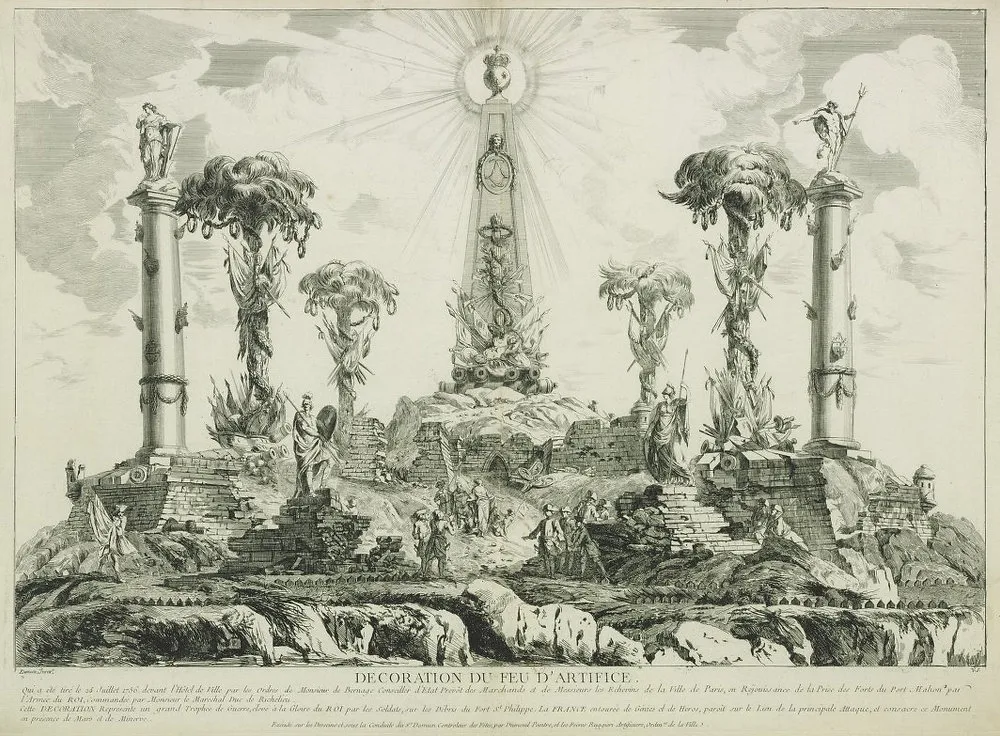
From the 17th to the 18th century, fireworks became a fixture in Europe’s great monarchies. They marked dynastic marriages, treaties, princely births, military victories, and diplomatic events. In France, as elsewhere, pyrotechnics became a tool of political staging. It gathered crowds, impressed foreign guests, and translated power into spectacle.
These displays, however, remained very different from modern shows. Colors were still limited, ignition methods less precise, and accidents more frequent. Beauty came from scale, sound, the symmetry of set pieces, wheels, fountains, and rockets. The pyrotechnician was therefore chemist, builder, stage designer, and field operator all at once. Their mastery was measured by powder quality, trajectory calculation, and the ability to orchestrate a sequence legible to the audience.
The 19th century: the color revolution
The major aesthetic turning point in pyrotechnics came in the 19th century with advances in chemistry. Metal salts made it possible to obtain a wider range of colors: strontium for reds, barium for greens, copper for blues, sodium for yellows, and calcium compounds for oranges. The introduction of new oxidizers and metals such as magnesium or aluminum also increased luminous intensity.
This evolution profoundly changed how fireworks were perceived. The display was no longer limited to a bright explosion; it became a palette. Pyrotechnicians could work with contrasts, scenes, bouquets, transitions, and nuances. Pyrotechnics then entered a new era: one of visual composition, where every color, duration, and height contributed to the overall emotion.
From artisanal know-how to spectacle engineering
In the 20th century, fireworks changed scale. National celebrations, world fairs, major sporting gatherings, and cultural events established pyrotechnics within the landscape of contemporary festivities. Manufacturing techniques became standardized, safety rules were strengthened, and pyrotechnicians professionalized their methods. The challenge was no longer simply to produce a spectacular effect, but to do so with precision, consistency, and control of risk.
The arrival of electric ignition, followed by computerized systems, marked a new stage. It made it possible to synchronize launches to the tenth of a second, multiply firing positions, create complex rhythms, and combine fire with music. Fireworks became pyromusical: a visual score in dialogue with sound, place, and audience anticipation.
Today: an art of precision and emotion
Contemporary pyrotechnics combine artisanal heritage with cutting-edge technology. Behind a few minutes of wonder lie months of preparation: product selection, scenario writing, site analysis, safety distances, mortar installation, programming, checks, and team coordination. Each show is a collective work in which creativity must be balanced with regulations, weather, acoustics, and visibility.
In international competitions, this level of demand becomes even greater. Pyrotechnic houses defend a signature, a style, a way of writing the sky. Some favor power and grand tableaux; others emphasize musical finesse, rare effects, silences, delicate colors, or the millimetric precision of sequences. The audience sees the beauty; professionals also read the technique, the timing, the clean burn, the balance of the program, and the artistic coherence.
A history still in motion
From Chinese black powder to pyromusical shows, the history of pyrotechnics is therefore more than a chronology of inventions. It is the story of an art that transforms a chemical reaction into shared emotion. Fireworks remain popular because they speak immediately to everyone: they gather gazes, suspend conversation, and inscribe a memory into the night.
Their strength lies in this paradox: they are fleeting, yet unforgettable; technical, yet poetic; dangerous if not mastered, yet profoundly unifying when entrusted to professionals. More than a thousand years after their Eastern origins, pyrotechnics continue to write a universal language in the sky—one made of light, rhythm, and wonder.