21 September 2019: the Grand Finale of the Gold Master in Compiègne
On 21 September 2019, the Masters de Feu brought together the Italian, Greek, and French winners of the first three editions at the Compiègne racecourse. A Grande Finale conceived as a gala event, with three creations in competition, a blind vote, and the Master d'Or in sight.
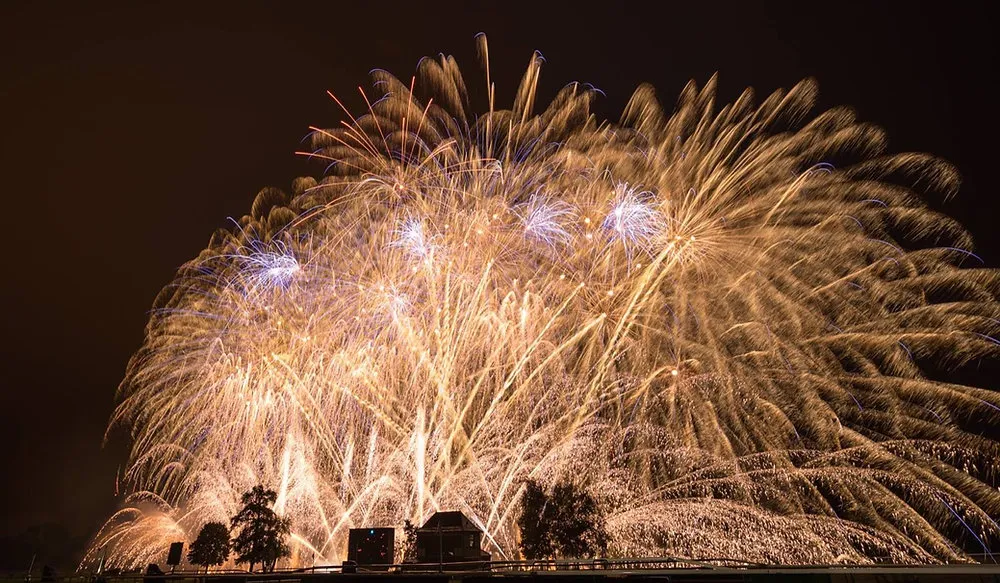
On Saturday, 21 September 2019, Masters de Feu invited the public to the Compiègne racecourse for a truly exceptional evening in the competition’s history: the Grand Final of the Gold Master. After three qualifying editions, three pyrotechnic houses returning from Italy, Greece and France faced off in a duel of excellence. The stakes went beyond a single evening’s victory: it was about crowning the best of the winners, the one capable of turning fifteen minutes of fire, music and precision into a moment of pure spectacle.
A final shaped as the pinnacle of a first cycle
Since its creation in 2016, Masters de Feu has established in Compiègne a format rarely seen in the European pyrotechnic landscape: three years of competition to select winners, then a grand final bringing those winners together around a higher trophy. In 2019, this first cycle reached its conclusion. The three finalists were therefore far more than mere guests: each had already impressed the jury and the public in a previous edition, and each knew the demands of the site, the scale of the production and the expectations of an audience that had become loyal.
The lineup brought together Parente Fireworks for Italy, Silver Master 2016 winner; Nanos Fireworks for Greece, Silver Master 2017 winner; and Grand Final for France, Silver Master 2018 winner. Three signatures, three fire cultures, three ways of writing in the sky. This clash gave the evening a distinctive depth: it was not only about visual impact, but about the ability to create a work that was coherent, moving, legible and perfectly synchronised.
On 21 September 2019, Compiègne took centre stage
The event began at 8:30 p.m. As in previous editions, the Compiègne racecourse became the great nocturnal theatre of pyrotechnics: an open space designed to welcome spectators in excellent conditions and give the pyrotechnicians the depth of field worthy of their ambitions. The audience was first invited to attend an opening show, then the three competing creations, before an out-of-competition finale.
This organisation gave the evening the rhythm of a gala. The opening act was designed to set the audience in the mood, to transport the venue into a world of imagination and to remind everyone that Masters de Feu are not a succession of fireworks, but a carefully scripted evening. Only then did the competitors take to the stage, each with the same amount of time to unfold their universe and defend their chances. The company ArtEventia, out of competition, provided the opening and closing shows, bringing the event its expertise in design and staging.
Imposed creations inspired by great works
For this final, competitors were asked to work around a prestigious theme: the great classics, also presented in the event’s communication as the great works. The choice was particularly apt for a Grand Final. It invited pyrotechnicians to engage with a musical and cultural heritage that is instantly evocative, while avoiding the trap of mere illustration. The challenge was to bring forth a fresh emotion from familiar references, to respect the momentum of the scores while extending them through light.
In a musical pyrotechnic show, success rests on a delicate alchemy. A burst fired one second too early weakens a crescendo; a tableau that is too dense blurs the reading of a musical phrase; a poorly chosen colour can break the atmosphere. At this level of competition, fire becomes writing. Pyrotechnicians do more than stack effects: they shape breaths, alternate masses and silences, build heights, depths and ruptures. The sky becomes a vertical score.
A blind vote to preserve fairness
One of the defining features of this Grand Final 2019 was the evolution of the judging rules. To ensure the greatest possible fairness, competitors were identified by a number rather than by their country or company. The jury therefore voted for a creation, not for a nationality. This decision carried particular weight in a final where the French team was competing at home, before an audience and in an environment naturally inclined to be sensitive to its presence.
Each performance was judged according to precise criteria: overall aesthetics, emotional impact, synchronization with the music, and the diversity of choreographed effects. These criteria recall what sets a major fireworks competition apart from a traditional festive display. Power alone is not enough. The jury examines the structure, the finesse of the transitions, the mastery of the effects, the inventiveness of the tableaux, and the ability to sustain a narrative from the first spark to the last burst.
Italy, Greece, France: three fireworks traditions in competition
Parente Fireworks represented Italy, a country with a long pyrotechnic heritage deeply tied to major popular celebrations. Its return to Compiegne extended the 2016 victory, the first edition of Masters de Feu, when the Italian house made a lasting impression. Nanos Fireworks carried the colors of Greece, following its 2017 success at an edition inspired by Europe’s capitals. Grand Final defended France, buoyed by its 2018 Silver Master, won on an evening themed around cinema.
These three finalists arrived with a particular responsibility: not merely to reproduce what had earned them victory, but to take things to the next level. A final calls for added risk. One must surprise without losing clarity, impress without overwhelming, move the audience without slipping into mere decoration. For spectators, this lineup promised a fascinating reading of Europe’s different fireworks sensibilities: the elegance of composition, the force of the rhythms, the richness of the colors, the precision of the launches, and the artistry of the grand finale.
An evening sold out well in advance
From the moment the event was announced, demand was strong. The original article recalled that the grandstand was already full and invited spectators to reserve without delay the last remaining seats. This detail says a great deal about the anticipation surrounding this Grand Finale. In just three editions, Masters de Feu had succeeded in establishing a recognised appointment on the calendar: family-friendly, spectacular and exacting, capable of bringing together enthusiasts and the merely curious alike.
On 21 September 2019, Compiègne was therefore hosting not just a competition: the city was witnessing the culmination of a story that began in 2016. The audience came to rediscover a ritual, but also to experience an event unprecedented in its intensity. Three winners, three countries, one stage, one theme, one goal: to win the Gold Master.
The winners of a Grand Finale that has become a benchmark
Since that evening, the 2019 results have entered the history of Masters de Feu. The 1st Prize Master d'Or was awarded to Grand Final, for France. Nanos Fireworks, for Greece, took second place as well as the Audience Award. Parente Fireworks, for Italy, finished third. This result gave the 2019 Grande Finale a foundational significance: that of a first cycle brought to its peak, then passed on to the following editions as a model of drama, rigor, and shared emotion.
Revisiting the announcement of 20 February 2019 today brings back the energy of anticipation: the promise of an exceptional night, the suspense between three already acclaimed winners, and the ambition of a competition that sought to raise pyrotechnics to the level of stage art. On 21 September 2019, that promise found its expression in the sky above Compiègne, between music, fire, and memory.