Philippine International Pyromusical Festival 2018: Manila, capital of musical fire
From February 17 to March 24, 2018, the 9th Philippine International Pyromusical Competition brought together in Pasay, near Manila, several leading pyrotechnic names from Europe, North America, and Asia. On the bay, the SM Mall of Asia provided a spectacular setting for this event, where music, precision, and skywriting take center stage.
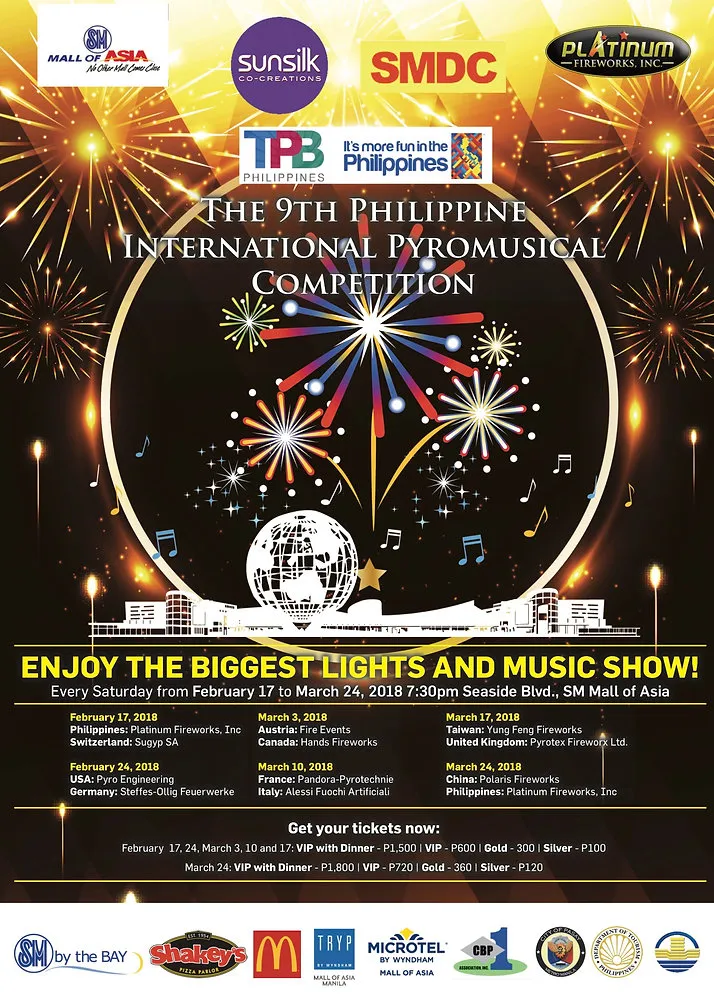
In Manila, fireworks do more than light up the sky: they converse with the sea, the crowd and the music. From February 17 to March 24, 2018, the 9th Philippine International Pyromusical Competition transformed the area around the SM Mall of Asia in Pasay City into a vast stage opening onto the bay. Every Saturday evening, spectators settled in facing the horizon to attend pyromusical creations from several continents. The principle is simple, yet demanding: combine the visual power of fireworks with a soundtrack crafted to the millisecond, then win over both the audience and the jury. In the world of major international competitions, the Philippine event holds a special place, thanks to its popular format, its maritime setting and its ability to bring very different fireworks houses together around the same standard of spectacle.
An international competition facing Manila Bay
Over the years, the Philippine International Pyromusical Competition has established itself as one of Asia’s major musical fireworks events. In 2018, the competition takes place over six consecutive Saturdays, starting at 7:30 p.m., in the SM Mall of Asia complex. The venue is no accident: set on the waterfront, in one of Metro Manila’s busiest areas, it creates a spectacular perspective, between the seafront, urban silhouettes and the tropical sky. The bay acts like a mirror, extending the plumes, comets and bouquets into a visual depth few sites can offer.
The 2018 edition is announced as the ninth in the competition’s history. It brings together ten foreign teams in competition, plus two performances by the Philippine host, Platinum Fireworks Inc., responsible for opening and closing the festival. This presence of the host country, outside the competition, gives the event a ceremonial dimension: the Philippines welcomes, frames and celebrates the competition, while allowing the invited delegations to defend their artistic signature.
Six evenings, ten signatures and two major Philippine shows
The 2018 schedule illustrates the diversity of the lineup. On February 17, Platinum Fireworks Inc. delivers the opening show before Switzerland, represented by Sugyp SA, takes the stage. On February 24, the public discovers the United States with Pyro Engineering, then Germany with Steffes-Ollig Feuerwerke. March 3 sees Austria, led by Fire-Events, share the evening with Canada and Hands Fireworks. March 10 features a particularly European lineup: France is represented by Pandora-Pyrotechnie, facing Italy and Alessi Fuochi Artificiali. On March 17, Taiwan, with Yung Feng Fireworks, precedes the United Kingdom, represented by Pyrotex Fireworx Ltd. Finally, on March 24, China, with Polaris Fireworks, presents its show before the Philippine closing performance by Platinum Fireworks Inc.
This structure, two performances per evening, creates a true dramaturgy. The audience does not simply attend a fireworks display: it compares styles, tempos, colors, ways of building a finale or interpreting music. Some teams favor density, others choreographic precision. Some play with verticality and broad openings, others work on low sequences, fans, facade effects and rhythmic breaks. That is the essence of a pyromusical competition: the technique is visible, but the writing is felt.
Music as the backbone of the show
In a pyromusical display, the soundtrack is not just accompaniment. It dictates the architecture of the show. Launches must match the accents, silences must be respected, and orchestral build-ups must find their equivalent in the sky. In Manila, this dimension takes on particular importance, because the crowd is large, responsive and highly attentive to major emotional moments. A spectacular effect launched at just the right instant can transform a sequence. Conversely, a technically impressive show that is poorly synchronized loses intensity immediately.
Fireworks teams engaged in this type of competition must therefore master several languages at once: pyrotechnics, of course, but also rhythm, storytelling and spatial management. The choice of music shapes the overall tone: epic, pop, lyrical, cinematic, heritage-based or decidedly contemporary. The challenge is to avoid flat illustration. A good pyromusical show does not merely highlight the key moments; it creates breathing room, momentum and sometimes even surprise. Colors, firing heights, calibers and textures become instruments.
A lineup that reflects the global pyrotechnic scene
The list of 2018 participants offers an interesting snapshot of the international pyrotechnic landscape. Europe is strongly represented, with Switzerland, Germany, Austria, France, Italy and the United Kingdom. North America is present through the United States and Canada. Asia is represented by Taiwan, China and the Philippines. This geographic diversity enriches the competition: traditions, industrial approaches, musical sensibilities and firing habits differ from one country to another.
For the participating houses, such a stage is also a showcase. An international competition makes it possible to test an artistic approach, measure oneself against other teams and demonstrate expertise before a large audience. The names on the program are not mere effect suppliers: they are show designers, capable of composing a complete experience from technical constraints, safety rules, a site, a fixed time slot and musical dramaturgy. This dimension echoes the spirit of the major European competitions, where execution is judged as much as originality and overall coherence.
The French evening: Pandora-Pyrotechnie on the Pasay stage
French participation on March 10, 2018, fits into this logic of excellence and international circulation of talent. Pandora-Pyrotechnie represents France during an evening shared with Italy, another major fireworks nation. This face-off is symbolic: both France and Italy have a strong tradition of fireworks spectacle, between popular celebrations, major events, urban scenography and specialized competitions. In Manila, the challenge is not only to produce a spectacular finale, but to defend an artistic identity in a highly competitive setting.
For French observers, this kind of event has particular resonance. It is a reminder that pyrotechnics is a deeply international art, where houses travel, meet, inspire one another and distinguish themselves through style. Masters de Feu, in Compiègne, belong to that same competition culture: bringing together top-level fireworks artists, confronting creative approaches, showcasing musical synchronization and offering the public a demanding reading of the spectacle. Whether it is a Silver Master, a Gold Master or a Platinum Master, the logic remains the same: to bring out a signature through precision, emotion and intelligent construction.
A popular, spectacular and highly photographed event
The success of the Philippine competition also lies in its broad public appeal. The SM Mall of Asia, one of the country’s major shopping and leisure hubs, makes it possible to combine a family outing, a seafront stroll and a nighttime show. The competition evenings become urban events, attracting enthusiasts, photographers, tourists and residents of Metro Manila. In such a setting, fireworks take on an immediate collective dimension: they are watched live, but also carried on in images, videos and shared memories.
Manila Bay heightens that visual memory. The reflections, the open horizon, the presence of the crowd and the proximity of the city create an almost cinematic setting. For the teams, this scale is both an opportunity and a challenge. A site so exposed requires a design that remains legible from a distance, capable of reaching spectators seated facing the firing area, as well as those viewing the show from nearby surroundings. The clarity of the sequences, the height of the effects and the strength of the finale become essential.
What the 2018 edition reveals
Beyond the program, the 9th Philippine International Pyromusical Competition confirms the worldwide appeal of pyromusical contests. These events are no longer merely displays of power. They highlight precision, creativity and the ability to tell a story in just a few minutes. Contemporary fireworks are judged by their relationship with sound, by their dynamics, by their balance between surprise and control. In Manila, in 2018, every Saturday offered a variation on the same ambition: to turn the night into a score.
For Masters de Feu, following these major international events makes it possible to place the Compiègne competition within a living network of pyrotechnic stages. From the Philippines to France, formats differ and landscapes change, but the goal remains the same: to offer the public a rare moment, where technique disappears behind emotion. Manila Bay hosted, for six weeks, this universal dialogue between music and light. A festival distant in geography, yet close in spirit: that of an art of the sky, shared, compared and celebrated on a global scale.