The Silver Master: the founding trophy of Masters de Feu
In 2016, the first edition of Masters de Feu launched in Compiègne an international competition conceived as a grand stage for pyrotechnicians. At the heart of this founding evening, the Silver Master honored the best of the three competitors and opened the path to the Gold Master.
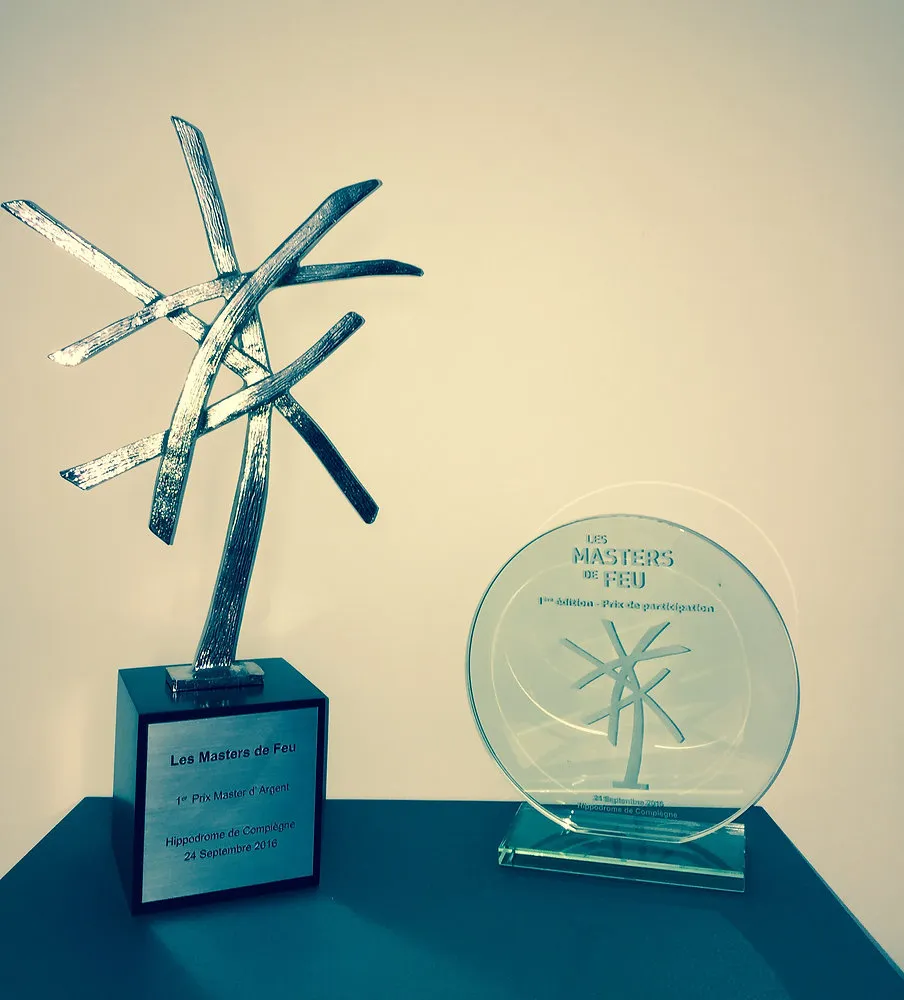
On September 24, 2016, the Hippodrome de Compiègne hosted the very first edition of Masters de Feu. More than a grand fireworks spectacle, the event laid the foundations for an international competition destined to become a lasting fixture in France’s calendar of major fireworks events. At the heart of that inaugural evening: the Master d'Argent, the trophy awarded to the best of the three competing pyrotechnicians and the first step in a journey designed to lead the winners toward the Master d'Or.
A trophy embodying pyrotechnic excellence
A competition needs rules, a jury, artists and an audience. But it also needs a symbol. For this first edition, the Master d'Argent was not just a prize awarded at the end of the contest: it stood as the visible emblem of a new ambition. The ambition to make Compiègne a meeting place for the finest fireworks houses, pyrotechnics enthusiasts and spectators eager to discover fireworks in a different way.
Created by the Editeo house, this metal trophy translated into matter a gesture typical of pyrotechnics: the ascent of a palm shell, whose sparks seem to unfold in the night. The choice of this motif was no accident. In the vocabulary of fireworks, the palm effect evokes verticality, expansion, the power of lift-off and the nobility of the luminous fall. In a single form, it captures the full drama of a successful performance: the rise, the anticipation, the explosion, and then the lingering emotion.
The Master d'Argent, the first step toward the Master d'Or
From the outset, Masters de Feu was conceived as a progressive competition. The Master d'Argent rewarded the best pyrotechnician in a qualifying edition. The winners of the first years were then to come together for a final, with the Master d'Or in sight. This structure gave the competition a special depth: each evening was not isolated, but contributed to building a record and a story.
In 2016, three European pyrotechnicians competed for the first Master d'Argent. Spain, Italy and Austria were featured in the competition program, while France was set to close the evening with an out-of-competition fireworks display. This lineup immediately set the tone: Masters de Feu was not limited to a local or national showcase, but affirmed its international vocation from the very beginning.
History will remember that this first distinction opened the way to the first major Masters de Feu cycle, leading toward the Master d'Or. But when the trophy was presented, a few days before the evening, the main challenge was above all to help the public understand what was at stake: not merely a succession of fireworks, but an artistic confrontation between styles, sensibilities, musical writing and pyrotechnic signatures.
A jury facing a demanding decision
Awarding a Master d'Argent means looking at fireworks differently. Spectacle matters, of course: the height of the effects, the richness of the tableaux, the intensity of the finale, the power of the colors. But a pyrotechnic arts competition depends on a subtler evaluation. The jury must observe the precision of the firing, the coherence of the show, the balance between sequences, the use of the sky, the synchronization with the soundtrack and the pyrotechnician’s ability to tell a story in just a few minutes.
This task is delicate, because pyrotechnics first act on the senses. They provoke an immediate, sometimes almost physical response: the blast, the light, the rhythm, the anticipation, the surprise. The jury’s role is therefore to look beyond the dazzle and discern the composition. A memorable fireworks display is not reduced to a thunderous finale; it is built like a score, with nuances, breaths, breaks, recurring motifs and effects that dialogue with the music.
For this first edition, the decision carried particular weight. The winner did not simply take home a trophy: they became the first name entered into the competition’s history. The 2016 Master d'Argent was thus to identify the first competitor chosen to continue the adventure toward the Master d'Or final, giving the inaugural evening a founding dimension.
The audience, an active part of the evening in Compiègne
Masters de Feu was also designed as a shared experience. In Compiègne, the audience does not simply attend a show from the lawn or the stands: it takes part in a competitive evening, with expectations, preferences, discussions and predictions. This collective dimension is part of the event’s identity. Each spectator looks at the sky with their own imagination, yet all experience the same moment, in the same night, beneath the same bursts of light.
The invitation for the public to share their opinion strengthened this closeness between the pyrotechnic stage and the spectators. In an art where emotion is immediate, popular reception matters. It does not replace technical judgment, but it reminds us that fireworks are also an art of gathering. The finest pyrotechnicians know how to speak both to connoisseurs and to families, to enthusiasts able to identify a rare effect and to visitors seeking the magic of a major outdoor evening.
Compiègne, a new stage for a fireworks tradition
By choosing the Hippodrome de Compiègne, Masters de Feu took its place in a territory already associated with major fireworks displays. The Oise retains a strong memory of fireworks competitions and large nighttime gatherings. The creation of Masters de Feu responded to that history: to extend a tradition while offering a renewed format, more legible, more competitive and designed to establish an annual fixture.
The Compiègne venue offered a setting well suited to that ambition. A pyrotechnic competition requires space, depth, controlled technical areas, but also comfortable seating for the public. The magic happens when the apparatus disappears behind the emotion: the pyrotechnicians work backstage, the teams prepare the firing lines, the safety measures are set with precision, and then the sky suddenly becomes the main stage.
A first edition marked by promise
Just days before the 2016 edition, the Master d'Argent thus symbolized far more than a prize. It announced a method, a standard and a promise: to bring together top-level pyrotechnicians, pit them against one another under comparable conditions, offer the public a show of scale and set the winners on a path toward the Master d'Or. This first step was meant to establish the identity of Masters de Feu: a competition, but also a celebration of pyrotechnic creation.
The trophy imagined by Editeo expressed that ambition with elegance. Its metal silhouette, inspired by a palm shell, captured in lasting form what fireworks naturally offer only fleetingly. Therein perhaps lies the full strength of the Master d'Argent: turning the ephemeral into memory, light into distinction, the emotion of one night into a milestone in history. For Masters de Feu, this first edition was not merely a launch. It was the ignition of an international adventure destined to make Compiègne shine in the sky of pyrotechnics.