International fireworks competitions: pyrotechnic excellence in competition
From Mediterranean bays to major urban parks, international fireworks competitions have become the most demanding showcases of pyrotechnic artistry. They bring together leading houses from around the world around a shared challenge: turning technique, music and light into collective emotion.
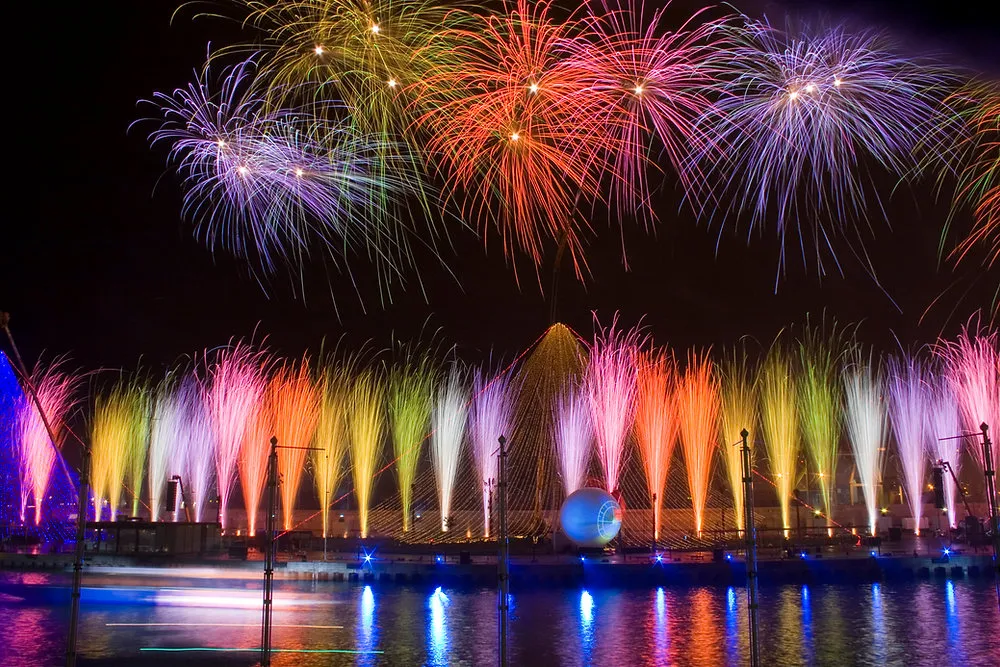
In the world of pyrotechnics, competition is far more than a pretext for spectacle. It is an open-air laboratory, a place of creative rivalry where fireworks designers bring their style, musical writing, technical precision, and ability to surprise into focus. From one city to the next, from one continent to another, major international fireworks competitions attract large audiences, attentive juries, and some of the most inventive pyrotechnic houses. For professionals, taking part means defending a signature. For spectators, it is a rare opportunity to compare several visions of the same art over the course of a few incandescent nights.
Why fireworks designers seek competition
Fireworks are an art of the moment: they are born, unfold, and disappear within seconds. Yet behind that apparent fleetingness, every show requires weeks of concept development, programming, product selection, site scouting, and team coordination. Competition gives fireworks designers the ideal setting to push that standard even further. It imposes shared constraints, stimulates invention, and makes it possible to assess a creation not only for its visual impact, but also for its dramatic structure.
In an international competition, a company does not come merely to “fire a beautiful display.” It comes to tell a story, defend a pyrotechnic culture, command a space, and demonstrate the ability to write with light. Effects are no longer simply added together: they are composed. Silences, breathing spaces, crescendos, rhythmic breaks, and final bouquets become the elements of a true score. It is precisely this artistic dimension that sets major competitions apart from simple festive displays.
Criteria that go beyond the power of the final bouquet
The public often remembers the color, scale, and emotional force of a finale. The jury, however, observes everything: the use of space, the variety of effects, the quality of transitions, musical synchronization, the originality of the concept, the consistency of the firing, and safe execution. A display that is too dense may impress without convincing. Conversely, a stripped-back sequence, perfectly synchronized, can reveal remarkable artistic mastery.
The contemporary trend is clearly moving toward pyromusical shows, where the soundtrack is not an accompaniment but the framework. The tableaux are conceived measure by measure, the firing is programmed with ever finer precision, and the colors respond to the musical atmosphere. This form of writing requires a dual skill set: intimate knowledge of pyrotechnic products and a genuine sense of editing, rhythm, and emotion. International competitions therefore reward artisans and technicians, but also directors.
The major events that showcase pyrotechnic art
Among the best-known competitions, L’International des Feux Loto-Québec in Montreal holds a special place. Launched in 1985 and hosted at La Ronde, it brings together international teams in a spectacular format linked to the tradition of major pyromusical shows. The 2026 edition marks its 40th anniversary, a sign of the strength of an event that has become emblematic of Montreal summers.
In France, the Festival d’Art Pyrotechnique de Cannes is a benchmark. Since 1967, Cannes Bay has provided the setting for shows created by fireworks designers from around the world. The sea, La Croisette, the firing barges, and the perspective offered to the audience create an exceptional natural stage. The competition notably rewards ambitious pyromusical creations, judged as much for their virtuosity as for their ability to enhance the site.
Spain also has a strong tradition, with events such as the Concurs Internacional de Focs Artificials Ciutat de Tarragona, held on the Catalan seafront, or the Concurs Internacional de Focs d’Artifici de la Costa Brava in Blanes. These competitions are rooted in a popular culture deeply attached to fire, celebration, and craft mastery. Further north, the international competition in Hanover, set in the Herrenhausen Gardens, combines pyrotechnics, music, and baroque architecture. In Malta, the Malta International Fireworks Festival reflects another facet of this culture, deeply rooted in local festivities and supported by a wide diversity of teams.
What competitions bring to the public
For spectators, a competition changes the way a fireworks display is experienced. You no longer wait only for the final bouquet: you observe the progression of the show, the coherence of the theme, the relationship between music and light, and the way each team builds its world. In a single evening or across several dates, audiences discover that two fireworks designers can approach the same brief in radically different ways.
This comparative dimension makes the experience especially vivid. Some favor power and large calibers, others finesse, low-level effects, rare colors, or highly musical sequences. Some shows win over the crowd with immediate energy; others leave a mark through elegance, poetry, or boldness. Competition educates the eye without ever taking away the sense of wonder. It gives the public the keys to an art that is often admired, but still too rarely explained.
Masters de Feu, an international stage in Compiègne
In Compiègne, Masters de Feu is part of this great tradition of international pyrotechnic competitions. Since 2016, the event has brought together companies from different countries, a jury, and the public at the Hippodrome de Compiègne for an evening designed as a true championship of creation. The rule is essential: competitors work within a common framework, with a theme, a duration, and comparable conditions. The aim is to judge artistic vision and pyrotechnic mastery, not material advantage.
The Masters de Feu format highlights the clarity of the competition. The selection rounds make it possible to distinguish Silver Masters, who return for a grand finale and compete for the Gold Master. This progression creates a narrative across several editions: each winner does not simply claim one evening, but earns a place on a broader journey. In the world of Masters de Feu, this hierarchy of titles — Silver Master, Gold Master, Platinum Master — helps establish a strong identity, immediately recognizable to both the public and professionals.
A discipline in constant evolution
International competitions also reflect the changes shaping the profession. Digital tools now make highly precise synchronization possible, while organizers are placing increasing emphasis on the environment, firing zones, site cleanup, and reducing nuisance. Pyrotechnic creativity is therefore measured not only by the abundance of effects, but by the ability to deliver a show that is responsible, readable, safe, and memorable.
This evolution reinforces the importance of competitions. They showcase best practices, encourage innovation, and allow know-how to circulate between countries. Above all, they remind us that when fireworks reach this level of excellence, they fully belong to the realm of live art: a collective, technical, and sensitive work, written for a specific place and shared by thousands of eyes turned toward the sky.